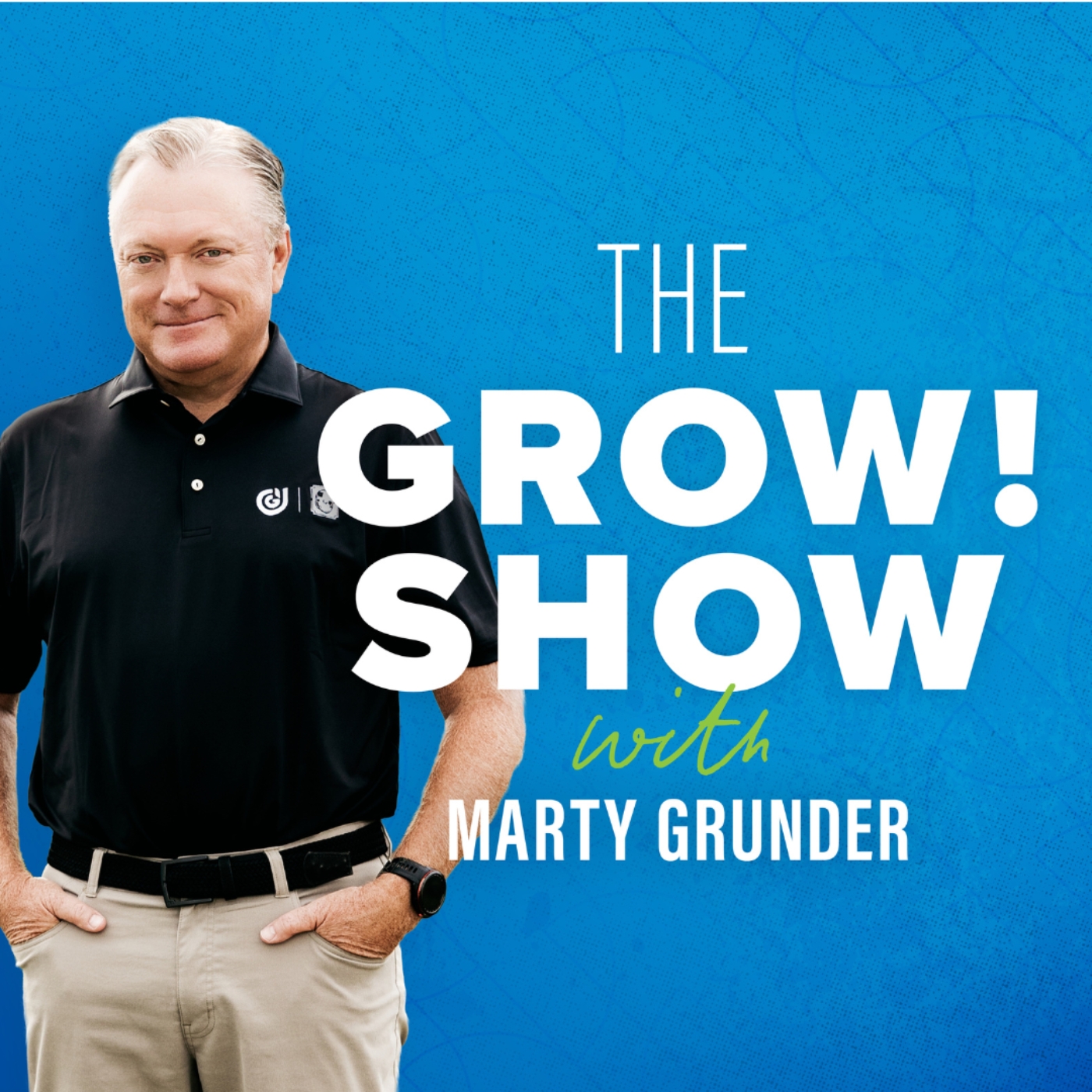
Episode Transcript
[00:00:01] Speaker A: Welcome to the Grow show brought to you by Marty Grunder's Grow Group, where we specialize in helping landscaping companies to clarify their platform, grow their people, build their processes and realize profits. Everything we teach is grounded in real experience. Our team is actively involved in the day to day operations of Southwest Ohio's Grunder Landscaping Company.
New episodes are released weekly on Wednesdays and are made possible with the support of Bob Yard. Remember to subscribe so you never miss an episode. Now, here's your host, Marty Grunder.
[00:00:28] Speaker B: Well, good morning, good afternoon, good evening, wherever the case may be. This is Marty Grunder from Grunder Landscaping Co. And the Grow Group. Thanks for downloading the Grow Show. We've got some new sponsors on the show, including Bob Yard, the AI tool that we use to bid work faster and more profitably. And today we are very excited to have the founder of Bob Yard on the show with us today. Michael Ding. It's going to be a fascinating and insightful conversation. But first, a reminder. You can get the latest edition of the Grow show delivered to your phone, tablet or computer by subscribing wherever you get your podcasts or Watch us on YouTube for an enhanced learning experience.
The Grow show is the greatest thing since leveraging technology in your business.
It's everywhere, folks, and some of it is a distraction, to be honest with you. But when you find something that enables you to spend more time with your team and your clients, you use it and you run.
Or what about the stuff like Bob Yard that helps you sell more and do more, you look at that and you implement it. I'm so excited about our future leveraging tools like Aspire and Bob Yard and a few others, but not 30 of them. We're going to get to new heights by focusing on a few great ones like Bob Yard. And now on to the Grow Show, Michael, a real industry trailblazer here in the area of technology for us green industry pros. Glad to have you here. Welcome to the Grow Show.
[00:01:51] Speaker C: Thank you, Marty. It's good to be here and you know, I appreciate the kind words.
You really have a lockdown.
I've listened to many episodes and you did it in one take. Just boom, boom, boom.
[00:02:05] Speaker B: I thrive on this. This is. I love speaking, Michael and the podcast here. I take it really serious. I love doing it.
When I was your age, I wanted to be a sportscaster on ESPN and it just wasn't in the card. So this is kind of my outlet and I try to be pretty good at it. So thanks for the compliment.
[00:02:24] Speaker C: Yeah, it's Amazingly consistent. It's not easy to do that.
[00:02:27] Speaker B: Well, thank you. You didn't come from the landscape background originally. You have a fascinating story. Can you talk about how you ended up where you are here with Bob Yard?
[00:02:37] Speaker C: Yeah.
Well, I think originally it. The idea started when I was at Stanford. I was taking real estate classes, and one of the professors ends up being like one of the investors in Bob, and he's advisor now, but amazing.
I was biking back and forth between this real estate class and this computer vision AI class. And eventually it took a while, but eventually I connected the dots. And I remember someone showed me a takeoff for the first time, and I thought there has to be. I was actually surprised that this was the standard way and the people that this was the intended way to do a takeoff. And I was pretty surprised. No one's tried something else before.
But I mean, I think it's a very quintessential Stanford experience.
It's not just the thing where students drop out now professors drop out of Stanford too.
It's an interesting experience, but I think I've always had a passion for the trades.
You'll notice, I think I was one of those little kids that watched Bob the Builder when I was a little kid. And it's why it's named Bob Yard.
[00:03:38] Speaker B: That's literally Bob the Builder was the inspiration for Bob Yard.
[00:03:42] Speaker C: Yeah, yeah, yeah. I think it's always been in sort of the back of my head. And so when I got older, I was always like, more conscious of the built world around me. And so, you know, maybe. Maybe more receptible to these ideas.
[00:03:56] Speaker B: Yeah, well, funny story. So my house was built by Bob, my son Grant, who is going to eventually become our Bob Yard super user.
[00:04:06] Speaker C: He's.
[00:04:07] Speaker B: He's on it. Well, I know you've had conversations with him.
He called him Bob the Builder. And he was about six years old when Bob was building the house and we actually had Bob the Builder. So maybe I'll put a picture of him up now just for some fun. So when you, I, you know, I'm very curious. You, you zero down on the landscaping industry, among others.
But when you first started working with landscaping companies, what surprised you the most about their operations?
[00:04:33] Speaker C: Well, so many things, actually. Like, we initially had a bunch of different trades, sort of as design partners.
We weren't so sure about what to focus on, actually.
We were working with electrical mechanical landscapers, and eventually we were like, screw it. We ditched everybody else but landscapers, and we just decided to focus on landscaping. This, like, you know, if you defend everything, you defend nothing. And so we have to focus.
And at the time, it was a very subtle decision, like, oh, we thought landscaping takeoff was very tedious, and there was a very high volume of landscaping takeoffs when we looked at drawings. But I think it ended up being a much.
What's like the Steve Jobs thing? It's like the dots only connect when you look backwards. And so it ended up being an amazing decision. And I think what surprised me is one just how insanely difficult it is to run a good landscaping business, especially one that's profitable for so long, like yours. It's like a miracle that these projects go up. It's like landscaping one of the last trades to go in a big construction project. And by the time you start, the whole thing's already delayed and the owners are yelling at you and whatnot. And landscaping has such a fragile sort of asset class. Like, your plants die if you don't. Logistics well enough, like every other trade doesn't have, that they have the luxury of just throwing their equipment around. But for landscapers, it's like, if you don't have the plants, if you don't ship the right number of plants, the right type of plants on the right day, like, I think you're kind of screwed for that week. And so very, very intense and fragile. Yeah, it's logistically, very heavy business.
Sort of always very impressed by the brains of, you know, all the people who've orchestrated these different landscaping businesses. And the thing is, like, there's so many successful landscaping businesses in the country, so many strong operators that sort of all come together and sort of solve this problem.
[00:06:19] Speaker B: I'm very excited and flattered to listen to you describe our industry that way.
I have family and friends that don't understand what the green industry is. They. I think they still think I'm just out cutting grass and, you know, blowing off sidewalks. They. They don't understand. I had a family member one time, Michael, close to 30 years ago, pulled up at our office, wanted to see it, and got out of the car and said, oh, my gosh. I mean, you have a real company.
I remember thinking, well, we. What exactly do you. Do you think I'm doing here? So I love the respect that you're paying our industry. When you started working with landscaping companies, what surprised you the most about their operations? And was there a moment when you realized that the estimating process, specifically takeoffs, was a major bottleneck? Like, where was the aha there?
[00:07:11] Speaker C: Yeah, there are so many things. I mean, actually, first off, I'LL say, like everybody thinks like sort of, you know, landscaping is an industry that hasn't been innovated in. And maybe that's the case. I think maybe that's the case from the outside, as in, like there haven't been many cool new technology providers that sort of innovate in this space. But the people itself are very forward looking. And I think a lot of landscaping owners care about legacy and sort of the future of the business. Maybe they're handing it off to the children or they want sort of the company to. And I think they do care about technology. I mean, you mentioned like Grant, your son, like, I think he's clocked in a few hundred hours in Bobyard or something like that. And you see that all the time. Actually there's a lot of super users of Bobyard and I think we're pretty excited about that and pretty surprised by that. It's like we sell a pretty sophisticated sort of advanced software tool and landscapers pick it up like it's nothing. And so I think that's one thing that's pretty surprising for takeoffs and estimates. I think we knew quite early on actually this was going to be pretty big. We had early demos, so we were showing people around and like it was pretty jaw dropping. Like we have some pretty crazy reactions that we get from customers when you do product demos. I think it's, it's because, you know, we have the opportunity now with technology to build something that's more than marginally better. And I think, I think a lot of things sell changes, changes about a business. If you can build something that's like, you know, an order of magnitude or one or two orders of magnitude better, it's like, you know, if you compare Bobyard to if we were marginally better than we say we're 10% faster, then it's kind of a hard sell. But then if you can build something that's 10 times better or 100 times better, then all of a sudden the conversation is very different. And I think that's really actually what's driven so much of the adoption of Popyard. But yeah, I think we knew right away that this was going to be something pretty big because the.
I think on average before Bobyard, I think 50% of the time of an estimator is spent just clicking on screens doing takeoff like of their entire day. When I think many of our customers, when they have estimators before Bob Yard actually the main job is actually to close deals like they're salespeople too. And if your Job is to bring in money for the company. But you're sitting around clicking on the computer all day, then, yeah, how does that work?
[00:09:23] Speaker B: Right.
[00:09:24] Speaker C: It's not the most sort of high leverage activity you can do.
Yeah.
[00:09:28] Speaker B: So you kind of touched on this. But I want to make sure it's clear, you know, why Bob Yard exists. So give us a little bit more detail into what Bob Yard is and the specific problem that it solves for landscape.
[00:09:45] Speaker C: The specific problem is, I think, I think improper sort of deployment of the talent in your team.
Estimators are some of the most sophisticated savvy people in your company. And there's a huge labor shortage. And estimators, there's sort of like a labor war going on for estimators in landscaping. It's funny in SF there's a huge labor war for AI talent. And I think for landscapers, it's the same thing for estimators. I think everybody wants a good estimator and they're so hard come by and very expensive to train and onboard and sort of retain. And we sort of just make sure that estimators spend time doing things that only they can do. And that comes in the form of automating a lot of the takeoff and estimating process.
Bob Yard basically is a modern takeoff investment suite. So sort of name any of the usual suspects. Sort of. We can do the manual flow, and then on top of that, we've added a bunch of AI models to help you go faster. We automate the bulk of the measurements for you, and people save quite a bit of time. Somewhere between 60, 70, sometimes 80% of the time.
I think Grant was telling the CS team like a four or five hour takeoff project for like a, you know, commercial site takes now like 30, 60 minutes or something. With Bobier.
[00:10:52] Speaker B: Right.
[00:10:53] Speaker C: That's like 80, 90% faster. And so we sort of just go through and count the plans, do length, do area measure, mulch, et cetera. And that way you get to focus, you, the estimater gets to focus on things that only you can do. You know, make decisions about the actual project, plan out how you would actually execute this in phases, think about the risk, think about, you know, different scopes that might be missing from the drawings, et cetera.
We do all the things that like no one really wanted to do to begin with, like counting plants.
[00:11:20] Speaker B: Well, it's not, you know, Bob Yard is a little bit. And it's much more sophisticated than this. But like, for example, Michael, we run Vermeer mini skid steers, which is a pretty Innovative. I call it the Swiss army knife of the equipment and landscaping. It's smaller than a skid steer. It's less expensive, it does less damage. If you have one in a trailer with implements, there's all kinds of things that it'll do for you.
You put it in the hands of the employee, they love it, they want to come into work, they want to run it. I see your product in a different way, solving the same issue. You're right. A lot of estimators are in sales, like Grant, my son, that's, that's running Bob Yard here, he's on a commission.
So the more bids that he gets out, the greater the chances he has for closing. When you're bidding commercial work, because I know, you know, you're not going to get them all. So you got to put a lot of stuff up on the wall. And if you get the job, Michael, as you know, it's got to be, it's got to be bid. Right. It's got to be bid accurately. And your, your comment there, I think that just rings home so much is you put an ad in the paper or, and I say the paper, the Internet, wherever you want to go. Indeed, you know, on LinkedIn to try to find an estimator. You're right, you're going to. That's impossible. But if you could take somebody on your staff and train them on Bob Yard and let that program do the work for it, that's what I see as you saw as the need. And you're absolutely right. That's. That's what was broken by about our industry. And you're fixing it. Is that a fair assessment?
[00:12:52] Speaker C: I mean, actually we would, we would hope that actually there are more estimators or more people that want to become estimators with Bobber, because I think it's easier now. Yeah, yeah. Like, I don't think anybody grew up like saying, I want to be an estimator. I want to, I want to count plants all day.
[00:13:04] Speaker B: Yes, right.
[00:13:05] Speaker C: And it's brutal. Like, I, I know like the, the what? It's like carpal tunnel. Like, you know, your risk, like arthritis. I know the rates for estimators are pretty high for that.
[00:13:13] Speaker B: Right?
[00:13:14] Speaker C: It's pretty brutal. And it's just like there's so many other things that, that sort of, they're demand some in the job of skill, of their skills. Like there's so many other things to do. Sort of an estimator, if, if you think about it like their bids on also determine your margins because if they Bid too high or too low, it really impacts your project.
[00:13:29] Speaker B: Amen.
[00:13:30] Speaker C: And here they are sort of counting plants instead. And there's so many more things that the company depends on them for. And I hope that with new tools that are better, more people would want to actually be estimators. I think there's a big shortage and sort of one of the many problems I think that we're trying to tackle.
[00:13:45] Speaker B: Were you surprised that there wasn't a tool that enabled you to do this? Was that like. And I love, I'm taking notes here, I love what you said. When you defend everything, you defend nothing.
So you made a choice to focus on the green industry with this tool. Were you surprised there wasn't something there?
[00:14:04] Speaker C: I was surprised. Hence why I think I started the business. But I think if you ask many founders that they'll say that, like, you know, if you ask them if they wanted to start the company again, they would say no, because it was so brutally hard. And sort of their.
In their naiveness, in the beginning of thinking this was an easy problem, they went ahead and did it.
And sort of. I think that's maybe similar as in, like, we thought this would be like, wow, how has no one done this before? And then we sort of did it. I was like, okay, I understand why now. It's so hard and no one's done it before. It turns out to be a stupid, hard sort of AI machine learning problem to train models, to read blueprints. I mean, like, everybody listening to this podcast probably knows, you know, reading landscaping drawings is like a stupid, hard problem.
[00:14:42] Speaker B: Like, there's ambiguity and it's not exciting. You're right, it's not.
[00:14:47] Speaker C: But it's sort of those like high volume, high, but also high risk and critical. Because if you miss something, then all of a sudden your project's screwed up. But yet there's so much of it to look through.
So I think that's actually a good indicator of something that you can actually automate with AI.
And that's one of the things I think AI is good at. It's sort of.
Well, in sf, in the tech world, I think people call it middle to middle instead of end to end.
Like a human is end to end. And you can give them, start a task, go, come up, find yourself, and then do the task, and then evaluate yourself on the task. But model is not end to end. They're middle to middle. You kind of have to set up the task for them and set up these evaluation and workflows to review the model. But Once you set it up and it's very well defined, it'll happily execute it forever. And so that's what models are good at. And it turns out to be, I think, a great use case and application for computer vision and this technology. But it's not easy to do what we've done. And I think we had to solve some pretty interesting problems. There's some, like, technical things that we've solved that I think aren't even articulated in sort of literature and academia. Okay. We got to actually name a few technical breakthroughs, but it's literally taken a team of PhDs from like, Stanford, Virginia Tech, like Princeton, to actually solve problems.
[00:16:02] Speaker B: Amazing. And you just said something that I think is so.
I think it's a dangerous slope and, and you fought through it. But I will often have somebody that we're working with at the grow group that we're coaching or working with, and they'll say, I'm really excited about this opportunity because no one's doing it.
And Michael, I'm old enough to be your dad, but my, my perspective on that often is, okay, well, the reason that no one's doing it, you better be careful. It might be because it can't be done or it's so tough.
And I think for you, you probably saw that, but you saw AI could be something that would enable us to transform estimating into the landscaping sector. And you fought through. Did you have a bunch of doubts? Like, you're in an incredible spot now. You just received a very large investment that's going to help Bob Yard go on to a. I mean, an incredible level. Amazing what you've done. I was. I can't remember if I was reading the New York Times or the Wall Street Journal. I think it was the Wall Street Journal. And I saw your picture and I'm like, what the heck? And then I read it and I was like, go, Michael, go. You look at you. Was there a time when you doubted it? Talk to us a little bit about that. That might be insightful for our listeners.
[00:17:13] Speaker C: Thank you. Thank you for pushing it around. I think. Yeah, we did get a nice piece on the Wall Street Journal. We didn't know it was going to come out on print as well. I thought it was just going to be digital. So I think we have a frame, somebody in the office as well.
[00:17:25] Speaker B: But I should send it to you if you need a copy.
[00:17:29] Speaker C: We should send it to other people. But I think it's more than just us raising around. I think it actually is a sign that venture capital and sort of the financial institutions in Silicon Valley finally sort of understand the opportunities in the landscape and construction.
[00:17:45] Speaker B: Listen to you. I'm going to clap right there because I was just with a group of landscapers, 300 of them yesterday in Boston, and somebody pooh, poohed private equity.
And I said, stop. I said, there's bad private equity and there's good private equity, but private equity has shined a light on our industry that wasn't being shined on it 10 years ago. They've been great for our industry. Michael, you're absolutely right.
[00:18:11] Speaker C: I, I do think, like, you know, the reason why America is like, you know, number one and, and why we have all the innovation and Silicon Valley is sort of the, the leading edges always because, you know, people are willing to take the risk and sort of underwrite you financially and sort of allow you to take these risks and sort of do these endeavors. I mean, maybe. Sorry, could you repeat the question? I have. I think we want to stop.
[00:18:33] Speaker B: I was saying, like, no, it's okay. I got you off track with the, with the clapping. Did you have doubts? Like, was there a time when you were like, man, I only, you know, did you tell your parents or a friend or a partner that, I don't know if this is going to work, man, I don't. Did you tell your professor, Like, I'm not, I don't know if I got this or not.
[00:18:53] Speaker C: I think we always had a lot of market pull.
I think there are doubts about little things like, okay, how do you launch this product? And the details of the product itself.
But there's a funny thing in startup world called product market fit. It's this mystical thing where it's like, does your product actually have demand in the market or not?
It's one of those things where if you build a product and you ask someone, would you buy or not? And what do you think of this product? If you say, oh, this is a great product, you know, I would love to use it. But then when it's time to actually pay for it, it's like, oh, you know, hold on a second.
[00:19:25] Speaker B: Writers, man. Somebody's. All your friends are going to tell you it's great. It's getting the money. That's the true test. You're absolutely right.
[00:19:31] Speaker C: There's a funny, like, you know, can you, can you sell it to your mom and the mom test. But I think, like, you know, a lot of people say yes and just be nice to, to you because you're a founder. Like, you're young. Oh, yeah.
[00:19:41] Speaker B: You are. That is spot on, Michael. 100%.
[00:19:44] Speaker C: Of course you should keep going. It's a brilliant idea. And then, you know, when you actually try to sell to them, it's like, very difficult. But actually, there's a concept that we care about, Bobber, which is like, you know, do the hard thing.
It's a comment on the thing. On markets. There's a famous book called Zero to One by Peter Thiel.
Like this PayPal founder and eventually Palantir founder.
And he's done a lot of things in the startup world, and one of his things is like, you know, um. Well, the actual saying is like, you know, competition's for losers and you want a monopoly. And, and sort of the best businesses ever are monopolies for him. It's like you don't want to compete. And, and, and if you're sort of like, you know, we're. We're the only French, you know, Thai fusion restaurant in the Bay Area, like, we have this niche that, that no one captures. We're going to be a killer business.
Yeah, yeah, you, you, you, you compete with every other restaurant in.
So it's sort of an artificial niche that you're trying to tell investors.
And I think the key for us is like, we try not to take shortcuts. In fact, we try to only take problems where there are no shortcuts for. And I think actually this deeper theory for this, it's like if you're in a market where there is a shortcut, then you have to take it, because if you don't take it, other people will take it and sort of everybody takes it. And so what comes easy goes easy, and you get a lot of revenue, you grow really quickly, but everybody else goes really quickly, and you end up competing very heavily.
But then if you do the opposite, you pick an industry or a market or a problem that only has a hard problem, only has a hard solution, and there's no shortcuts. The only way to solve it is doing this hard thing. If you do it, no one else can follow you except by doing the hard thing as well. And sort of the harder the thing you do, the more satisfied you can be that other people that want to follow us also has to do the hard thing.
It's not easy. I think it's the same with landscaping. It's not easy to set up a landscaping business and grow it and have a certain scale. I think, like hitting like 15, 20 mil as a landscape business is stupid hard.
And going to that scale and sort of maintaining it because it's like a few hundred people you have to run. And running a business for a few hundred employees is a big problem.
It's a huge, like a managerial problem. And so, you know, doing the hard thing. I think you should be proud of doing the hard things because you know that if other people want to follow you, they have to do the hard thing too. It's very hard.
[00:21:51] Speaker B: This isn't the same thing, but the same group yesterday that I was with in Boston, somebody made a comment, Michael, that there was a municipality that was impossible to work with because their permitting was so tough and they were so stringent on everything. And I said, well, hang on a second. I said, we have a local municipality that's that way, and they are very tough. And we figured out a way to adhere to their tough standards. And now they recommend us and we've got a presence. And I love the quote that you said.
You said, we take on the problems where there are no shortcuts. That is where you have market differentiation, where you stick with something and you find a competitive advantage because Bob Yard is going to do something that the others won't do. They gave up on it and we ran after it. And I, I think that is a. Whether you're in the Bob Yard today on the Grow show, we have Michael. Dang. Whether you're in the Bob Yard here or whatever you're doing, I do think when you take the road less traveled, as they used to say a long time ago, I do think that's where a lot of reward is. People don't want. They don't want headaches. And it sounds to me like you've embraced them.
[00:22:56] Speaker C: Yeah, I mean, yes, but. But also, like, you could just be wrong. And there's a reason why no one succeeded here.
[00:23:02] Speaker B: No, exactly. Right. You can't keep going. At a certain point, you gotta stop. I, I agree, but I also think that there's an initial response that that's too difficult. I don't want to do that. And I think that is where, you know, you're absolutely right. I mean, our revenue this year will be 20 million.
It's been very difficult. There's been growing pains. There's been things that I didn't even realize would be an issue that are an issue. I'm not quitting. I'm going to figure it out just like you're figuring it out. I mean, it's the same philosophy, the current landscape of estimating tools. There's spreadsheets, there's other takeoff software, there's industry platforms. Talk a little bit about all that stuff that's out there. And then let's also talk about if a company's looking at prioritizing, getting better at estimating and looking at software. Like, just give us a little insight into what's out there, what people are using, and why Bob Yard might be a great thing for them to consider.
[00:24:00] Speaker C: Yeah, well, I. I think that distribution. Distribution is about right, as in, like, there's like, you know, incumbent takeoff software tools. There's.
There's sort of like vertical full suite tools. And then I think a huge number of people use spreadsheets for estimating, for construction. And for us, I think, like, you know, we've basically, first of all, when we designed the product for bobbeard, we said even if the models didn't work that day because server outage, whatever it is, or maybe the drawings are really bizarre, you can still do the full manual takeoff flow in Bot Beard. And so we actually have full feature parity with any takeoff tool in the market. So anything you want to do manually in your current takeoff tool, you can do in Bobyard. So we never have to worry about that. And I think that's one of the choices that we don't want to have customers make is like, do I want the manual features that I currently have or the AI tools in Bobiard? You should just have both.
We're basically a full feature parity takeoff tool that's manual, like any of the existing ones. But we also train models to basically use models, most of it for you. We kind of train models to use the takeoff tool for you, and that's actually how you think of the models. I think the thing I'll actually say here is, I'm from Bobyard. We're trying to build a big business and don't take, I think, the vendor's words for it.
Everybody will say their product is amazing. I think what you should actually do is have a bake off, a B test the product, have some estimators, use some projects in your current takeoff suite, have some estimators, do some takeoffs with Bob grid and a B test and see how fast it can be.
I think that's actually one of the lessons that we've learned and sort of made observations about the market for. And we actually tell our customers to try to do this as much as they can. Our best customers are the ones that are most sophisticated and savvy about procurement. Like, if I go to a huge landscaping company with like 100 million revenue or more, they're like, hold On a second. Let me AB test this for a few weeks. Let me get some on this. Let me run a time trial. Let me see the ROI calculations. Let me actually build a financial model for the returns. I need to know if you're full of crap or not. But the smaller companies, when we talk to them, it's more like the emotional value of this saving me time. It's like, oh, this feels like it'll be this much faster, so hence it'll be worth this much to me.
I think that's fine. But when you go through the exercise of building the financial model, it also sort of shows your diligence about the business and how well do you know your business? What levers can you pull in your estimating team? What are the actual metrics that matter, and what levers can you pull to make the estimate team better? And I think it forces you to think about your own estimating team and the efficiencies there and sort of financially model your organization. I think it's been a helpful exercise for people that wouldn't have done it otherwise. And sort of we're like, okay, do the AB testing, and out of it, they actually have insights about the business that they didn't have before. So I think being diligent about decisions is always important. And this is one thing where, like, you know, your vendor should help you with this. It's like, we would love to help you run an A B test to figure out which tool is better for you. And sort of if vendors are not, then I think maybe there's something wrong. But we're very confident about it and sort of, I think that's a sign that, you know, we rely on the product for actually, most of our sales calls don't take our word for it. Don't take the demo for it. Just like, you know, try the product.
[00:27:03] Speaker B: Yeah, try it. See what it does. Right.
So I would be remiss if we did dig into some of your experience just overall with AI, and I know you're well in tune with it with Bob Yard. But how do you see AI changing landscaping operations over the next five years? And what areas do you think are most likely to be automated? Automated. I still hear some people talking about AI, and it's not the same thing, Michael, But I still hear them talking about AI like they talked about social media.
Like, I'm not getting on that, that we don't need that. And, you know, I've told people, like, look, okay, I'm 58, almost 58. All right, maybe you're not in to social media, but your future clients are. I mean, my 31 year old daughter Michael, she built a house and went with the builder that she met on Instagram. Okay. So I'm just saying like, you got to walk a day in your client's shoes and understand that like not everything is. You don't, not everybody else does things the way you do. So how do you see AI changing our industry?
[00:28:09] Speaker C: Well, I think this is the program thing, but maybe early on somebody else said it, but it's like, you know, don't go around with a hammer looking for nails.
Which is like, normally when there's a startup, like a new wave of technology, sort of innovation like AI or the Internet, it's actually not advised to go around being like, where can I apply AI in your business? Because you end up like, if you go around with a hammer, everything looks like a nail. Instead you have to actually find the solution and find the problem and apply the right solution. And funny enough, at Bobyard, internally we don't force anybody to use AI. We would have been like, we're not like, you know, you must use AI and use these tools. Instead we just ask people to deliver more. We just raised the bar on expectations. It's like, you know, I see people on the market, slash, other members of the team going crazy at being extra productive. I don't really care how you achieve that, but you got to be more productive. And I think that the easiest path, the shortest path is just actually to use AI tools. So I think actually it's like, you know, where in your business can you, can you find more efficiency and sort of be better? Where can you improve the workflows and then solve it with the right things? Sometimes it might not even be AI, just might be better systems and better software or better sops that you write for your team. But I think that the actual key insight is look for the problems first and then solve them with the right solution. But not be like, okay, where can you apply AI in your business? I think that's actually not always the right mindset. I think it's just like, where can we raise the bar and where can we improve our business in general? Where is a room opportunity? Where is the opportunity for improvement? And I think one interesting heuristic you can use is, you know, a business is like optimally running. If everybody in your business is only doing things that only they can do all the time. If you're ever doing things that you're not, the only person that can do it for Then maybe this is not the right sort of, like, distribution of tasks. And if you're only doing things that only you can do, then like, that sounds pretty good to me. And like, you have the highest leverage possible in your business. And so whenever you find opportunities like that, it's like, okay, can we automate this? Can we, can we redistribute a task somehow? And I think that's where you actually find opportunities.
[00:30:05] Speaker B: I mean, you are, you're right on. You're brilliant. And I think you make me think of something that I often struggle with in coaching entrepreneurs. They'll get this mindset that, you know, they're Superman, they got the S on their chest, and no one else can do anything. And I think actually when you look at AI and what it. What it may empower somebody, the ability to do, you know, we tell all of our clients in the grow group, Michael, look, if someone else can do it 80% as well as you, no, it's not perfect. But get off of it. Let them go. And news flash, when you started, you weren't that good at it either. So how did you get good at it? You don't get good at things if you don't try them. And I think you end up with a stagnant pond in terms of a culture. Like, there's nobody coming into the pond. It's a bunch of guys in there that are stuck. The thing smells, it looks great from a distance, but the closer you get to it, you don't want to be a part of that culture. And I think that, you know, I love what you said, that you don't insist that they use that, but you tell them they have to be more productive. And I think that when you can get someone to agree to this on their own terms and they see the benefit from it, I think that's probably from a leadership perspective, how you should do things.
[00:31:19] Speaker C: There's, there's so many things I can say about that. I mean, I mean, number one is like, I think for us, like a cool thing is leading by example. It's like, if you think, if you have an intuition that, you know, this AI tool might be cool, don't tell them to use it. Instead, just be like, okay, do a demo in an all hands or like a team meeting and be like, here's something I found. And boom, boom, look how fast it is. And then that they'll be like, wow, how do you do that? And they want to do it too, right? You can just show them how fast.
[00:31:46] Speaker B: That's a Super tip for an old guy like me to hear. That's great.
[00:31:50] Speaker C: But also, I think the second thing, going back to your previous point is like, you know, when do you.
I think as a business grows, your job as a CEO and owner is like, how can you like, sort of like hand off certain things? Because eventually as a company grows, you're the bottleneck. There's only one. And if someone's like 80% as good as you, I think actually maybe that's a heroistic for passing it off. But like, chances are if that person just focuses on that task, in a few weeks, it'll be better than you at what you're doing at that one task. And so I think specialization is very important. And of the biggest things about business is like, the whole point is to have a team and sort of increase your leverage by employing a whole team around you. If you, if you sort of, you know, yourself is not scalable, It's n of 1, but you need a team around you.
[00:32:31] Speaker B: You know, Michael, when I had some of my greatest epiphanies, I have four kids, they're almost 32, 31, 28, and Grant's 25.
And when I had an epiphany was about 15 years ago when my oldest, Emily, she works at the grow group, when she got her first job and she came home and she was telling me all the things that this company had her do and the onboarding they did.
And I started to really realize that I was terrible at this stuff. Like, I wasn't giving my team opportunities like my kids were getting the very first day at their job.
And I think you're so right to try to position it the way you described there is very smart. Would any of us want to go work someplace where no one ever lets us innovate or anyone ever gives us a little bit of money to experiment with someone or you're not allowed to try. Like, don't you dare call Michael's team at Bob Yard and do a demo without telling me. I mean, if that's the culture that you have where it's. That it's a dictatorship, I think it's very hard to grow. I don't think you're going to get innovation. And I think that's not an environment. I don't even want to say that that's not an environment young people want. I don't want to work in that.
Like, if I sold my business and you wanted to hire me and you told me, like, you will do nothing without clearing it by me first, I'D be like, Michael, I've spent my whole career as an. I'm not doing that. I don't, I don't want to be a part of that. Like, you don't think I bring something to the table and you're not going to trust me and let me go. And I know that's hard, but you don't have to, you don't have to give the new employee something that could be a hundred thousand dollar mistake, but you could give them something that might be a $500 mistake or $1,000 mistake. You can overcome that and the learning and the trust. And I think the other stuff that comes from that is very beneficial. Does that resonate with you?
[00:34:24] Speaker C: We have a saying at Bob Yard.
We care about ownership and we define ownership as how easy a night does everybody else sleep. Knowing you're in charge of the things you're in charge of. And it's resulted in great sleep, I think, across the team. But the point actually is like, did
[00:34:41] Speaker B: you come up with that on your own or is that something that you are inspired from someone else?
[00:34:46] Speaker C: I think, well, ownership is definitely not like, it's a general concept. I think many, many startups talk about this. But like, I think the sleep part is definitely for me because like, I think early on I was like, I find things I'm losing sleep about. I go to sleep worrying about this one thing and we basically just grill the person responsible for this until I sleep well on it and I stop worrying about it.
[00:35:06] Speaker B: And sleep's, oh yeah.
[00:35:09] Speaker C: And it's like, why am I worrying about this? This is your ownership. It means something's going on here.
[00:35:13] Speaker B: Don't take the monkey. Right, it's yours.
[00:35:16] Speaker C: And I think that's actually very empowering because if you tell the member of the team like, you're in charge of this and you're the only person in charge of this, and if this doesn't go well, your ass is on the line. They're like, oh, whoa, my work actually means something.
If I don't code this product well, a direct customer will be actually impacted by that. And so if they realize, oh no, my ass is on the line, but also that like everybody else is also working on things that they're in charge of.
[00:35:38] Speaker B: Yes.
[00:35:38] Speaker C: And you know, I'm working hard, I'm making sure my thing is going well and I depend on everybody else to work on their things and do their things well. And I think it's very empowering when you, when you actually, when you, when you care about something you spend more time to think about it and think through the decision and you actually learn more from it. And I think that that has to do with trust. You know, if you, if you don't trust the guy, then you won't give him the ownership. But if you don't give him the ownership, it means you don't trust them and the guy that like, right, great. People want to be trusted and want, they want to have autonomy. And we're pretty hands off on this thing. Like, if you own this domain and this sort of, you know, like this subset of the business, you have full freedom to make decisions about whatever you want.
You, you sort of are own. You own the end results and you can get there in however style you want.
[00:36:17] Speaker B: Fascinating discussion. We've talked about technology. I think I filled up three little stick notes with all kinds of quotes and things from you Learned a lot, man. Learned some things that have changed my perspective. I want to ask you a question as we get close to wrapping this up. If you were starting a landscaping company, what would you do?
Technology, the offering, what, just based on what you know about our industry now, I'm sure you've seen a lot of rights and wrongs. If you were starting a landscaping company, what would you do?
[00:36:49] Speaker C: Well, I think one of the themes was, has been like, you know, not to go around with a hammer looking for nails. And so I wouldn't be like, here's like no brainer software tools. I must get like. I think the only rule is that there are no rules. And so if someone tells you this is the standard thing that you must get, every business might get you maybe like, maybe not. Let me think about it. Like, you know, try the path that's, you know, not been walked before. And so if everybody else goes this one direction, maybe you actually shouldn't. Maybe there's no alpha to be had in there. But I think actually maybe the most important thing I can think of in general as I think team. One of the philosophies we have is every new hire we bring in has to be better than the previous, better than the average. And this is actually a very empowering thing too. It's like you keep hiring new people that are better than the average of the company. And so the current team, the previous people you've hired, is forced with the, well, forced the opportunity to grow and improve themselves. It's like, wow, this is a new bar.
I know now what caliber looks like. This is what I need to grow into. And the best hires are hires where they shattered the expectations. This person did better in the interviews than previously imagined possible.
You thought the previous hire was good. Holy crap. This new guy came in and crushed the interviews.
We keep trying to make them harder and harder, but people keep trying to question. And so I think that's actually, I think maybe the actual philosophies that matter in a business.
If you had the right team and you divvy up the ownership properly, like a lot of things go well. And I think that's actually the most important thing about like the thing I care about at Bobber the most is like my job now is just full time hiring and making sure people are motivated.
And I think it's actually the most important thing. Hiring, like hiring bring in new people that are stronger and stronger, like solves so many problems in your business.
[00:38:31] Speaker B: And the fact that you know that at your age. I didn't know that when I was your age. I didn't. I, I was a dictator with an emphasis on the dick. To be honest with you. I, I was not good. I was faking it till I make it. I was insecure, but I didn't want to let on that I would. There were just a lot of things and I, you know, it was one of the reasons I started the peer groups and started the grow group was I just didn't feel there were people out there to help you. And I wanted to create my own community that could help. And that's what we've done. But at the time when I was in my 20s, I wasn't comfortable asking for help. And now my mindset, Michael. And maybe this will help you a little. I know I'm good. I know I am. But if I'm going to be great, like, I got to listen. I can't think. I have it all figured out. I gotta, I have to, you know, like, this interview is very inspiring for me to talk to you, get to know you better, to learn more, what makes you click. There's numerous takeaways I can share. I'll be able to share these in my talks and my lessons and make other people better. And I think it's a mindset. And while I really admire you for what you've done with Bob Yard on the technology side, I also admire what you're doing from a leadership perspective.
[00:39:42] Speaker C: Thank you. We try. I mean, I do think, you know, self reflection is a very important skill and very hard. I think it's like it's super hard as a founder or an owner of a business because no one's gonna, I think it's very hard to have people tell you that. And I think maybe that's like the best possible leadership is when you can get people around you to actually tell you the honest truth and give you feedback on it. It's very hard for people that report to you to tell you you've made a mistake and very hard to make them have so much trust.
[00:40:12] Speaker B: How can people get a hold of Bobyard if they're interested in a demo or learning more, please.
[00:40:17] Speaker C: Yeah, bobyard.com, b o b Y A R D We just revamped the landing page actually. It looks pretty slick now. I think that the engineering and the design team did a great job on it. And you know, go to the website and there's some, there's already some cool things on there and you can probably see us at many of the. I think we're at grow this year and we'll be again next year.
And you know, I heard, I heard great things about that. And so you'll probably see us at one of the conferences actually probably as well.
[00:40:40] Speaker B: Well, I'd like to have you come to grow and put you up on stage. I think there's a lot we could learn from talking to you. I think you have some very. It's refreshing to me to listen to a young person that definitely has philosophies that are 100 years old and you definitely have philosophies that are new. And I think I'd like to think I'm the same way. Like I'm. I try very hard to learn from everyone I know I don't have it all figured out.
When you're in a position like you are, or to a lesser degree like I am, there's people, they look at you and they think you're perfect and that, you know, you don't have any issues and we didn't get into any of your big issues. But we're both dealing with stuff, we all are. And it's refreshing to hear someone with a good perspective around your team and letting them go that that's why you're growing, Michael. And that's why you got the large investment in Bob Yard that you did. And that's why I, I want to keep in touch with you. In fact, I'd probably highly recommend you move to Ohio, build a large house and let me landscape it.
[00:41:44] Speaker C: No, no, thank you. I really appreciate the kind words. I mean, but yeah, I think also it's like, you know, it is true that the public facing image of a company is very different than internals. And internals is a huge mess. There's, like problems everywhere and especially when you're growing. There's a lot of problems with growing because, like, all your systems, like, break down and you come up with problems you never imagined before.
Yeah.
[00:42:06] Speaker B: There are days I should probably send you my cell phone so we can commiserate.
[00:42:10] Speaker C: So, yeah, no, we'd love to catch up and yeah, we'd love to, but
[00:42:14] Speaker B: we're going to have you on again and we're going to keep in touch and you'll be talking to my son Grant. He's going to be a super user. We're, we're on our way there and I'm grateful for what you're doing for our industry and I'm grateful for the light that you've shined on us and you're trying to help all of us get better. You're a blessing. Thank you.
[00:42:28] Speaker C: Thank you. I appreciate it, Marty. Thank you. Thank you.
[00:42:30] Speaker B: All right, folks, that's going to do it for this week's edition of the Grow Show. If you haven't done so already, subscribe to the Grow show. And if you can give it a rating or leave a comment that helps more success minded landscape professionals find us. And if you really want to help us, take out your phone right now and and share this episode with a friend, a team member or any landscape pro you know. Thanks for joining us on the Grow show this week. Will talk to you next week.
[00:42:56] Speaker A: Thanks for listening to this episode of the Grow show and thank you to Bob Yard for their support of this episode. Visit growgroupinc.com for more resources to help your landscaping company succeed. We'll talk to you next week.